It is a way to continue to serve, to help shape services, treatment, care and programs for future veterans and for active duty members. I feel fortunate, I think all health researchers who work with veterans are fortunate to have the opportunity because we never forget that the life we lead, the freedoms that we have, can be related back to veterans. I thank them for their service and I end with, it's now time for me to serve you.
At the Chronic Pain Centre of Excellence for Canadian Veterans, we are the industry leader in funding veterans' chronic pain research. Everything we do is veteran-informed, and so we know that along with academic and research expertise, the lived expertise and experiences of Canadian Armed Forces veterans is absolutely essential in helping us understand and research chronic pain. That's why we have partnered with Canadian Armed Forces Veterans to bring you a brand new resource
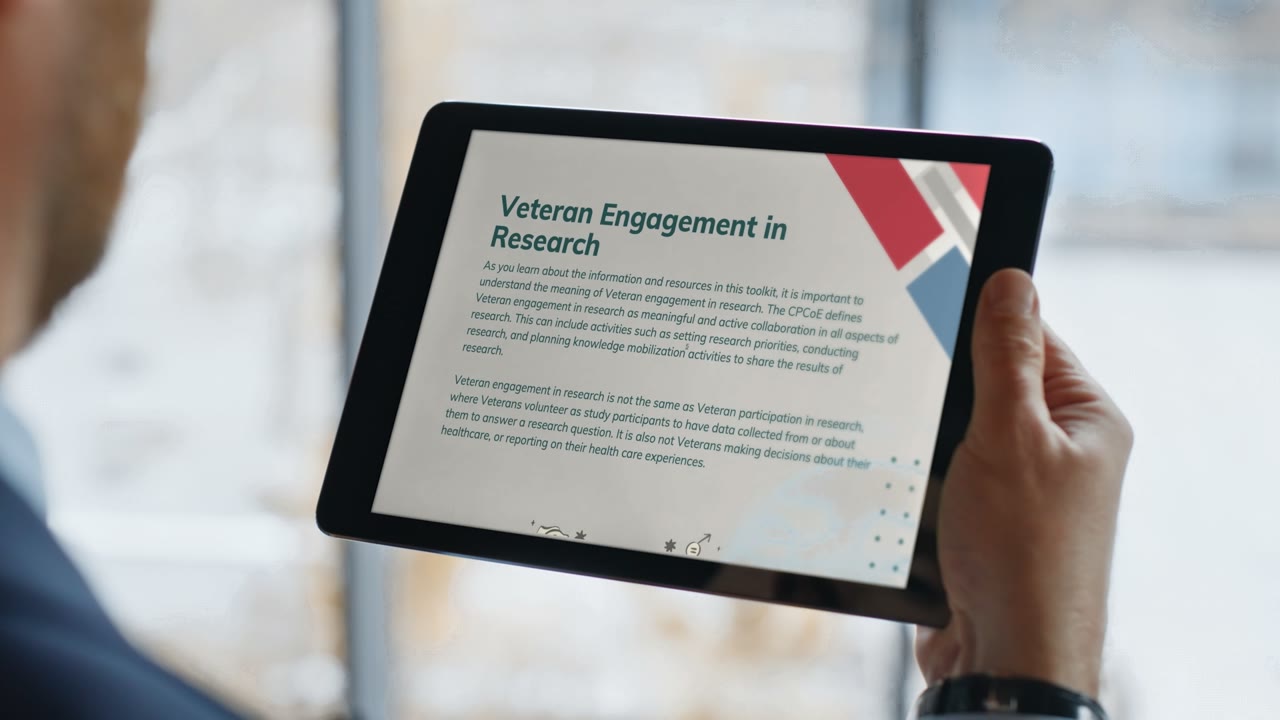
called the Veteran Engagement in Research Toolkit.
This is your one-stop resource,
everything you need to know about how to successfully and meaningfully engage Veterans
in research. The toolkit is more than just a document. It's a practical, hands-on resource
designed to help research teams engage Veterans with intention. Inside you'll find educational
modules, a national database to match veterans and researchers, and clear guidance on principles,
roles, and responsibilities, along with fair compensation.
Every part of this toolkit was
co-created with veterans themselves. It was really important for the toolkit to reflect the lived
experience because it needs to come from the people who lived it. So when we started to think
about the toolkit, it was how can we make sure that both populations, the research population,
and the veterans understand each other.
So all these steps of the process were co-created
and developed with veterans and other people
from the community, researchers, clinicians,
and people also from the civilian community. So veteran engagement is not a box to check. It's actually a complicated process
that you think about thoughtfully
in relation to the research question that you're asking
and how you make sure that all the voices
that you need to hear are around the table.
Every veteran has had a different military experience. They would have been sent to different places
with different terrains, different climate. So researchers really need to understand that process. I was a little bit intimidated
to start working with veterans. You don't want to offend anybody
and you want to be able to embrace
people's cultural practices.
But it can be hard if you don't know where to start,
which is why I think the toolkit is so helpful
because it gives you that starting point. I think the most important thing
is seeing people have a voice, veterans, spouses,
even children of veterans. That's why the CPCOE matters. You're not forgotten, you're not lost.
You will be seen and you will be heard
and what you say matters. If I can just help change one other veteran's life,
then all of this to me is completely worth it. At CPCOE, we're changing how research is done,
now and for the next generation. Building a future where lived experience
is valued just as deeply as academic expertise.
Whether you're a researcher, clinician, student,
policymaker, veteran, or conducting any type of research
and applying to any funder, this toolkit is for you. The toolkit is a tremendous way of setting the bar
for bi-directional conversations. It is extremely unique. It hasn't been done before. And I think for years to come,
it will make a difference in the lives
of veterans and their families. Together, let's create stronger research,
stronger partnerships,
and continue to serve our veteran community.