
Program Overview

With hundreds of thousands of Canadians living with dementia and the number climbing, AGE Inc. set out to deliver humanistic, patient-centred care. This program overview introduces their Gentle Persuasive Approaches curriculum and the compassionate philosophy behind it.


Client

AGE Inc.

Industry

Healthcare

Type

Documentary

Platform

Web & Social Media, Theatrical & Streaming Services

Audience

AGE staff, Caregivers, Care Organizations

About this project

In 2011, 747,000 Canadians were living with Alzheimer’s disease and other dementias – that’s 14.9 per cent of Canadians 65 and older. Which means that sadly, chances are high that you know someone who has suffered, or is currently suffering from these diseases.

As our population ages, these numbers are only climbing. The Alzheimer’s Society of Canada has estimated that if nothing changes by 2031, this figure will increase to 1.4 million.

In Canada, AGE Inc. has set out to provide humanistic, patient-centred care for people living with dementia. Their curriculum, GPA or Gentle Persuasive Approaches, provides a broad-based educational experience for caregivers treating people afflicted with dementias, allowing these front-line workers to truly connect with the person beneath the disease. It is a novel approach, and one that has had huge success within Canada.

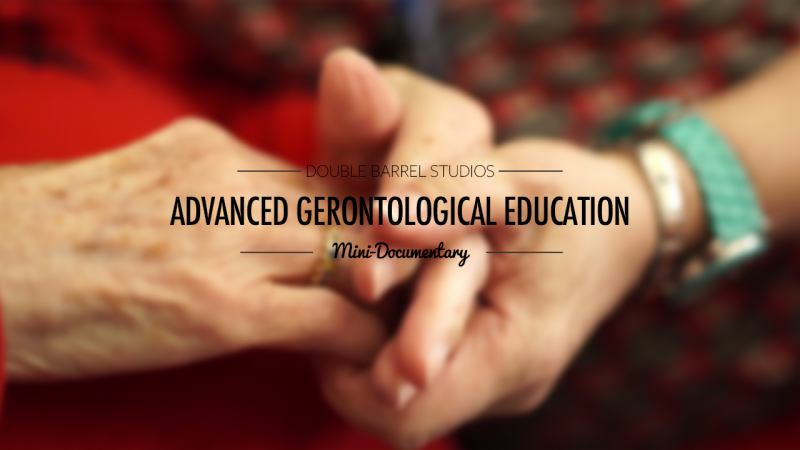
For the 10-year anniversary of the AGE curriculum, the team asked us to create a mini-documentary about the program. We were so pleased to be a part of the celebration for such an important organization. And by the end of our video screening, there wasn’t a dry eye in the room.

To the staff at AGE Inc. ~ thank you for including us! We were so happy to tell your story. Here’s to another 10 years of success!
Over the past 10 years, Double Barrel has worked with us on a variety of video projects (large and small) to heighten brand visibility and expand our reach nationally in the healthcare sector. The results have been superb — they were quick to grasp our mission and vision and run with it creatively. They are particularly respectful and accommodating of tight deadlines. As a not-for-profit, budgets are a crucial consideration for AGE. Double Barrel has helped us achieve high-quality, memorable and effective video storytelling while staying within budget. We highly recommend their services.

Patricia Boucher
Executive Director, AGE Inc.

Documentary | The Whole Person Approach to Dementia Care | Client: Advanced Gerontological Education (AGE Inc.) Transcript

We have to see this person as a whole person. You have to look at the holistic approach to this person. It's not just this person in room 622, it's Mrs. Such-and-Such or Mr. Such-and-Such and they used to be a wife, they used to be a mother, they used to be involved in their community. I really like green tea. Good for you.

This is Shirley McGill. She is a patient at St. Peter's Hospital. She's a very friendly, very enthusiastic, very social lady that we love to have in any of our programs that we offer through Therapeutic Recreation Services. This is Kim who helps me with a lot of horticultural things and other activities. We've done a lot of bocce ball, bowling, social programs that I'm very thankful I have that I wouldn't have ordinarily.

And surprising that I can do. Everyone's very kind and very helpful, and I think they have a lot of concern for us. Gentle persuasive approaches has been a real act of love. There were a number of collaborators who were really interested in the fact that there was a tension between safety of staff. And person-centered care and person-centered care.

We created this particular training education program to help staff feel more confident when they were caring for older adults with cognitive impairments like Alzheimer's disease. The gentle persuasive approaches or GPA is a curricula that has been developed and evaluated and is really looking at providing that frontline healthcare worker with education and training on dementia care. There are four modules in the dementia curricula.

That first module, the person-centered care module, is the most important for staff to understand they cannot look after somebody if they don't know who they are. So that's our impact. Boom. Right away. The second module includes brain and behavior. And all of the various details with respect to how the brain is impacted by dementia.

So that these behaviors that the individual resident displays are understood from a brain etiology perspective. Then the third module deals with communication strategies. Communication is key. Absolutely key. You've got to recognize that this person has brain damage, but you need to look at the way you're communicating with that person to be able to get a positive effect.

And the fourth module includes strategies that healthcare providers can use to reduce the likelihood of injury to themselves or to the resident patient. We know that over the coming two decades, our older population is going to double the numbers. And we also know that the people living with dementia is expected to double as well.

And that means that we're going to have more people living in our communities. We're going to be interacting with the health system who actually have dementia. And also have responsive behaviors as well. What I'm particularly impressed is, is that the GPA work, um, they've been researched and shown that it can really improve the confidence of the staff who take these programs so that they can better, uh, manage situations that sometimes they might think is catastrophic.

And now they realize they're actually highly manageable. We've also seen great evidence to show that this sort of work, uh, and this sort of training has actually helped, uh, to improve the actual care. Um, that's being received by older patients with dementia as well. It's really important that we have curriculums like these that, uh, can really empower, uh, frontline workers to have the knowledge, skills, and attitudes they need to provide the responsive care that older patients with dementia, uh, really deserve.

Ten years in the process of developing GPA and we're still going strong. It just blows my mind really on where we've come from and the vision of where we're going and the opportunities. I've always been very passionate about this curricula. So I get goosebumps when I talk about it. I believe this curricula can really make a big change.

We knew in our hearts that this was something that was innovative and novel that wasn't offered to anybody else. And we've been quite successful. Now that we're at 10 years, our goal is to spread the word and embed this curriculum in all the training programs for healthcare providers. And I think we'll make great inroads.

Person-centered care. I think it is a part of my being always has been. And that's why I'm in this field. I guess it's the most important thing to me, um, in my role is to try to make a difference. Person-centered care. No one knows what their time is. And I feel so grateful that they will let us into that time. Um, they don't know me when they come in here.

There's sometimes they're only here for days, weeks, maybe months. And, um, for them to let me into that part of their life and try and bring them joy or allow them to have joy back in their life. Person-centered care. Person-centered care. That's very fulfilling for me. To, um, enable them to enjoy the rest of the life that they have. Person-centered care. It's teaching you how to be so compassionate, too. I'm very grateful. Very grateful.

Documentary | The Whole Person Approach to Dementia Care | Client: Advanced Gerontological Education (AGE Inc.)

Explore our Work