

Parks Canada

This animated educational series dives deep into whale tour operator regulations and guidelines within the Saguenay-St. Lawrence Marine Park, a treasured National Marine Conservation Area in Canada. Attention to detail was paramount, ensuring learners could seamlessly absorb information, from whale perspectives to regional geography, meticulously crafted to perfection.


Client

Parks Canada

Industry

Education

Type

Animation, Training

Platform

Web & Social Media

Audience

Whale tour operators & the general public

About this project

This series of animated educational videos focusses on whale tour operator regulations and guidelines in the sensitive Saguenay-St. Lawrence Marine Park; a National Marine Conservation Area and one of only three in the Canadian national park system.

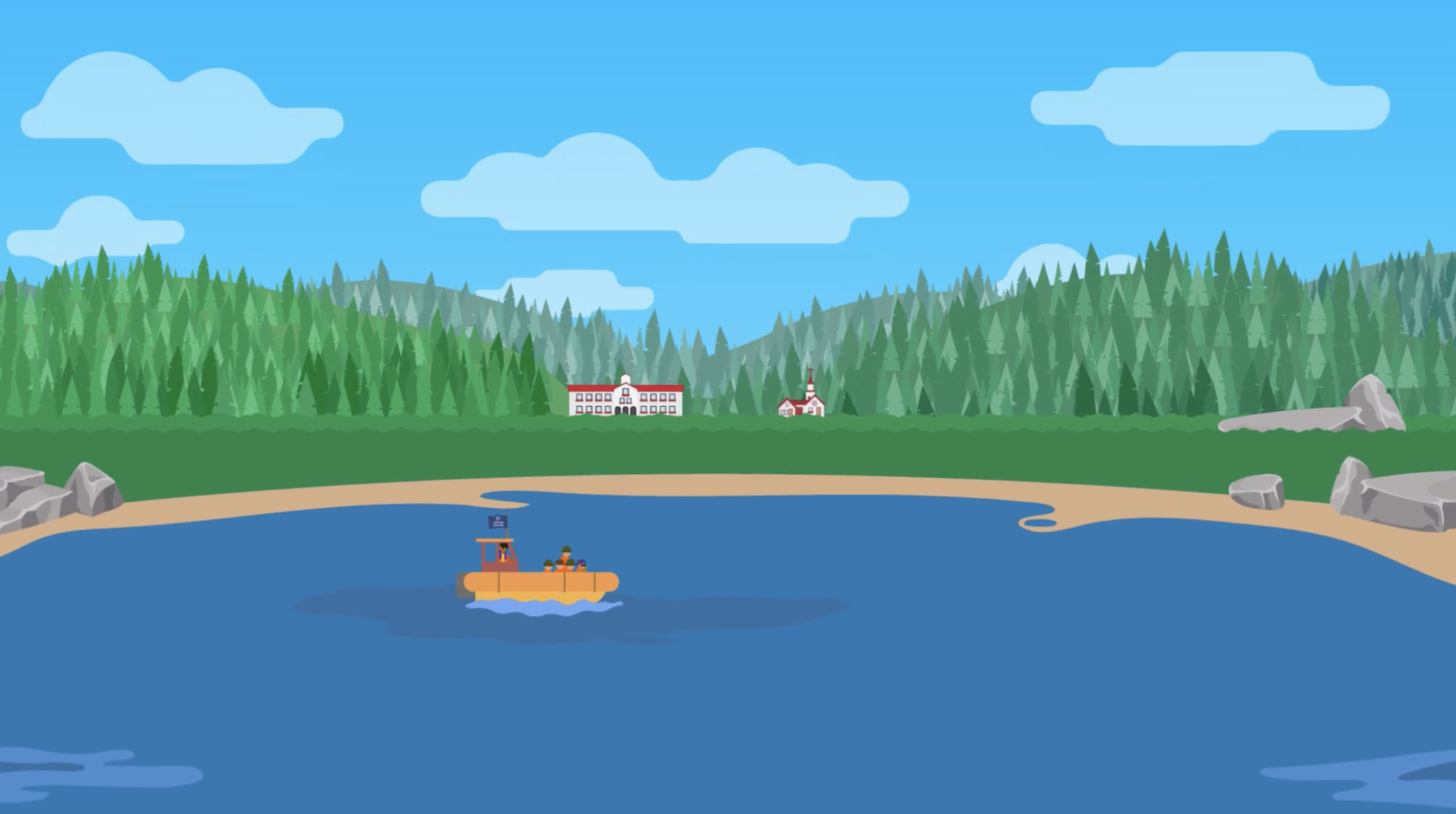
With educational projects it’s often critical to get the smallest of details absolutely perfect, to not impede the learner’s ability to grasp the information being shared. In this case, extra close attention was paid to the distances, perspective, style and movement of the whales & the overall geography of the region, often having our illustrators pull from actual photos in the creation of these elements.

Produced, voiced and titled in both of Canada’s official languages – we are so proud of the results of this collaboration! Many thanks to Parks Canada for involving us in such a fantastic project. We had a whale of a time!
Parks Canada – Whale Tour Operator Series #1 Transcript

Imagine that you are heading towards an observation site, looking for humpback and minky whales. Arriving near the site, you notice that it's very busy. Several boaters and excursion boats are present. What is the best way to proceed? First, before you arrive in the observation area, call your colleagues on Channel 8 in order to know how many Class 1 boats are present.

Remember that a maximum of 10 sea excursion boats are authorized in an observation area. Count the number of Class 1 boats present. If there are already 10, you cannot enter the area. Continue your cruise by looking for another observation site. But if there are less than 10 boats, enter the area by sailing at a maximum speed of 10 knots until you are in observation mode, or 400 meters, from a whale.

You may approach the whales at minimum speed, to a distance of up to 200 meters, or 100 meters away if the conditions of the approach privilege are met. Now, you want to leave the observation site. What is the best way to proceed? First, announce your intentions on Channel 8. Proceed at your minimum speed until you are at a distance of 400 meters away from the last whale.

Then, increase your speed to 10 knots, as long as you are in the observation zone of the nearest boat. Since the area you are leaving is busy with feeding whales, you may encounter more wildlife, including whales that you haven't seen before. It's important to increase your speed gradually, to a maximum of 25 knots, and resume your movements.

At all times, remember: never cut the path of a whale, or make changes of direction repeatedly, and do not use the wind, the currents, or the waves to get closer. You must wait one hour before returning to an observation area, and keep a minimum distance of 400 meters with belugas, blue whales, and right whales. Have a good trip!

Parks Canada – Whale Tour Operator Series #2 (FR) Transcript

Le Règlement sur les activités en mer dans le parc marin du Saguenay-Saint-Laurent fixe la distance d'observation de la plupart des espèces de baleines à 200 m. Dans certains cas, les pilotes de bateaux détenant un permis d'excursion en mer classe 1 ont la permission d'approcher les baleines jusqu'à une distance de 100 m pour les observer. C'est ce qu'on appelle un privilège d'approche.

Voici quelques situations où il n'est pas possible de profiter d'un privilège d'approche. Première situation : la baleine est au repos. Deuxième situation : une baleine est accompagnée de son baleineau. Troisième situation : plus de quatre bateaux se trouvent à moins de 400 m de votre bateau. Quatrième situation : vous êtes en mode d'observation et un rorcal bleu fait surface à moins de 400 m de votre bateau.

Il n'y a aucune autre baleine ou aucun autre bateau de 100 m à 200 m de vous. Vous devez vous éloigner du rorcal bleu à vitesse minimale pour atteindre une distance d'au moins 400 m de lui. Il se peut ainsi que vous perdiez votre privilège d'approche et que vous deviez trouver un autre site d'observation. Cinquième situation : d'autres bateaux et vous êtes en mode d'observation de plusieurs baleines et un rorcal bleu fait surface à moins de 400 m de votre bateau.

Vous devez faire preuve de prudence et utiliser votre jugement pour vous éloigner une distance de plus de 400 m du rorcal bleu. Profitez de l'occasion pour expliquer à votre groupe que la présence et le bruit des bateaux dérange les baleines et que vous prenez donc ces mesures pour aider à protéger le rorcal bleu, une espèce en voie de disparition. Rappelez-vous en tout temps de ne jamais vous mettre sur le chemin d'une baleine ou d'effectuer des changements de direction à répétition et de ne jamais utiliser le vent, les courants ou les vagues pour vous rapprocher des baleines.

Vous devez attendre une heure avant de retourner à cette zone d'observation et conserver une distance minimale de 400 m des bélugas, des rorcal bleus et des baleines noires. Bonne excursion!

Parks Canada – Whale Tour Operator Series #3 Transcript

The mouth of the Saginae is a very busy area, both for boats and ferries, and also whales, particularly belugas. We must be extra careful in this area, so how do we navigate there? Imagine that you have come to observe whales off Tadesac when approaching buoys S7 and S8 slow down to a maximum of 15 knots. This measure is effective from May 1st to October 31st of each year.

You see a group of belugas in the mouth, towards Pointe Noir, and a minke whale at Pointe de Lillet. Your presence in the beluga habitat can divert their attention and reduce the time they spend taking care of the young, feeding and resting. They need space and tranquility. So how do we avoid disturbing them? First, slow down between 5 and 10 knots.

When the belugas are within a half nautical mile from your boat, do not stop. Next, make sure to keep a heading to navigate more than 400 meters from the belugas. If a minke whale arises 200 meters from your boat, slow down to the minimum speed to maneuver, without stopping, until it is more than 400 meters away. Remember you cannot stop to observe a whale as long as you are within a half nautical mile from belugas.

Navigate between 5 and 10 knots until you have found a distance of more than half nautical mile from the belugas. Continue at 15 knots until you have crossed the ferry line. Remember that if you see belugas, there may be others closer to your boat you haven't seen yet. Continue your course with caution. You may come across them again.

Pilots and naturalists, take the opportunity to explain to your group that the presence and noise from boats has impacts on whales, and you are taking these measures to help protect the beluga, an endangered species. At all times remember, never cut the path of the whale or make changes of direction repeatedly. Do not use the wind, the currents, or the waves to get closer, and keep a minimum distance of 400 meters with belugas, blue whales, and right whales. Have a good trip!

Parks Canada – Whale Tour Operator Series #4 Transcript

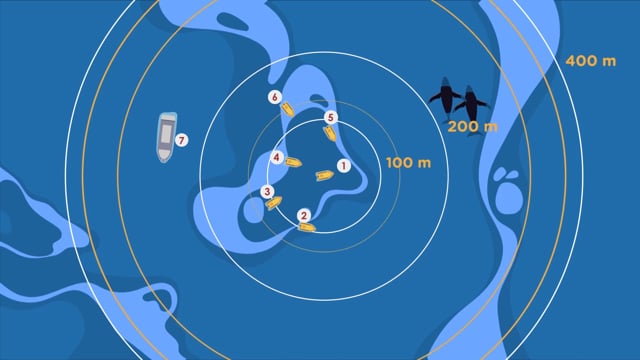
Operators navigating in the Saguenay-Saint-Laurentz Marine Park must observe a variety of distances when on the water. It's important to develop a method of evaluating these distances for yourself using a combination of radar, AIS, and visual cues such as buoys. Always observe the following distances when on the water: 1/2 nautical mile, or 400 meters for observation mode, 200 meters when approaching a whale, and 100 meters, which is a privilege of class 1 boats only.

Now imagine that you are on the move. The maximum authorized speed is 25 knots. You spot a group of fin whales and go to observe them. At a distance of 400 meters from a whale, you are in observation mode. An observation zone, of half nautical mile, is created around your boat. In this area, the speed limit is 10 knots for all boats, whether or not they observe whales.

You can approach most whales from a distance of 200 meters, or up to 100 meters for class 1, if they are not threatened or endangered. To approach between 400 and 100 meters, navigate at minimum speed to maneuver your boat. You can enjoy observation at these distances for one hour. If other boats join you, an observation zone is created around each one.

And if these areas touch, you are now in an observation area. There can be a maximum of 10 boats holding a sea excursion permit in an observation area. At all times remember: Never cut the path of the whale, or make changes of direction repeatedly. Do not use the wind, the currents, or the waves to get closer. You must wait one hour before returning to the same observation area.

And keep a minimum distance of 400 meters with belugas, blue whales, and right whales. Class 2 boats are not authorized to enter an observation area, or to approach whales to observe them. And only boat pilots holding a class 1 sea excursion permit can approach 100 meters from whales. Refer to the regulations for more information, and have a good trip!

Explore our Work